‘Black Mirror’ ‘Common People’ Ending Explained: Why The Episode Feels So Hopeless
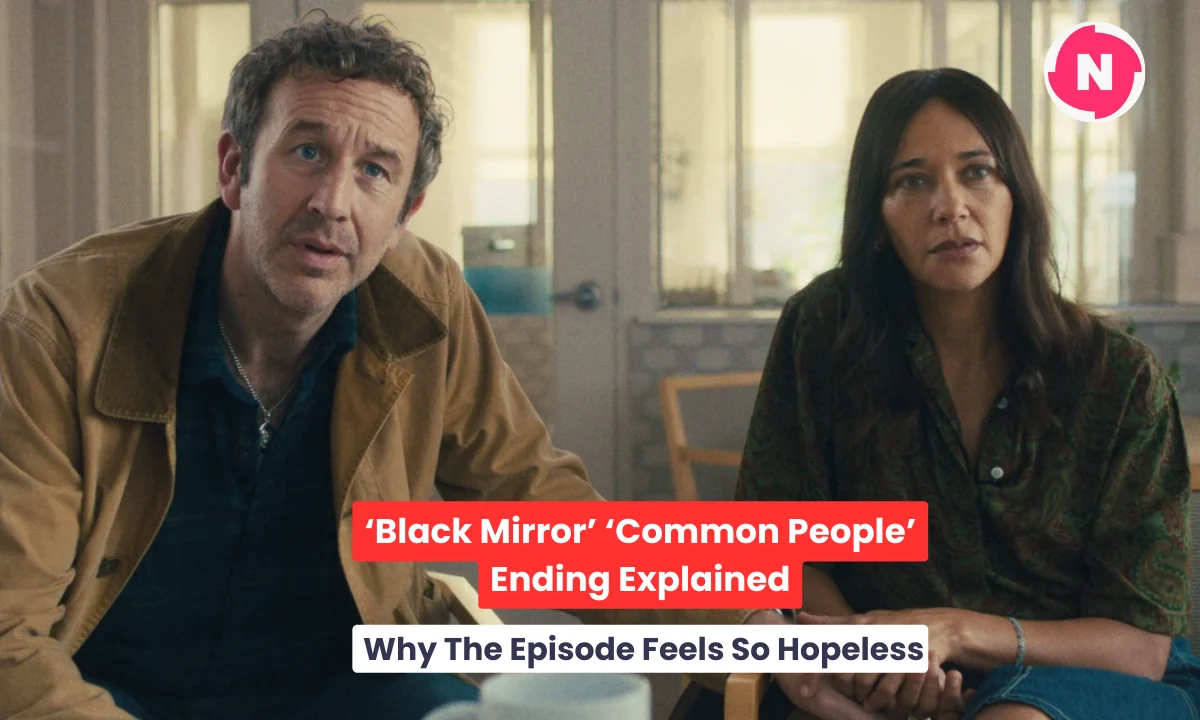
‘Black Mirror’ ‘Common People’ Ending Explained Why The Episode Feels So Hopeless
The Black Mirror episode Common People is not shocking because of a twist. It hurts because everything feels inevitable. From the first subscription upgrade to the final scene, the episode quietly pushes its characters into a corner with no clean exit. The ending has left viewers disturbed, emotional, and arguing about what it really means.
This article explains the ending of Black Mirror – Common People, what actually happens to Amanda and Mike, and why the episode is being called one of the bleakest stories the show has ever told.
Key Takeaways
- Common People critiques subscription-based healthcare and late-stage capitalism
- Amanda’s death is framed as a conscious choice, not a medical failure
- Mike’s final scene strongly implies total emotional collapse
- The ending mirrors real-world fears around ads, AI, and paywalled survival
- Public reaction shows deep emotional impact and cultural relevance
The ending of Black Mirror Season 7’s premiere episode Common People has sparked intense debate because it does not rely on sci-fi spectacle. Instead, it shows a slow collapse caused by money, technology, and systems that refuse to care. The episode follows Amanda and Mike, an ordinary couple whose lives are destroyed by a life-saving technology that operates like a subscription service.
At the heart of the episode is Rivermind, a brain implant system that keeps Amanda alive after a severe medical emergency. What begins as hope slowly becomes control. Each upgrade costs more. Each downgrade takes something away. By the end, survival itself feels rented, conditional, and cruel.
What makes the ending so disturbing is not just what happens, but how quietly it happens. There is no dramatic countdown. No villain monologue. Just two people realizing there is no version of the future where dignity survives.
WHAT HAPPENS AT THE END OF COMMON PEOPLE
Amanda’s Final Decision Explained
By the final act of the episode, Amanda’s quality of life has completely collapsed. She is constantly exhausted, frequently unconscious, and regularly hijacked by intrusive advertisements that she does not remember delivering. These ads cost her professional credibility and personal dignity.
The crucial detail is that Amanda is aware of what her life has become.
She understands that every upgrade buys temporary relief and every downgrade takes away more of her agency. Even Rivermind’s highest tier only offers short bursts of peace. It is not a cure. It is a pause button that requires constant payment.
When Amanda tells Mike that she wants to die, it is not a moment of panic. It is calm, deliberate, and clear. She asks him to do it “when I’m not there,” referring to the moments when her mind is overtaken by advertisements and she is no longer conscious.
This detail matters. Amanda is not choosing death out of confusion. She is choosing control over the only thing she still can.
WHY THE PILLOW SCENE IS SO DISTURBING
The Meaning Behind The Ad Blackout
The episode’s most unsettling moment happens when Amanda begins delivering an antidepressant advertisement mid-sentence. Her tone changes. Her presence disappears. She is technically alive but no longer mentally present.
That is when Mike smothers her.
The scene is disturbing because it reframes mercy through technology. Amanda is only “not there” when the system removes her consciousness. The same system that promised to save her life becomes the condition under which she can die peacefully.
There is no dramatic music. No final words. Just the sound of an advertisement continuing as life fades away.
This moment underlines the episode’s core message: when systems control survival, even death becomes monetized.
WHAT HAPPENS TO MIKE AFTER AMANDA DIES
The Final Scene Explained
After Amanda’s death, Mike is shown entering a small room used for livestreams on the site Dum Dummies. He carries a box cutter knife. He closes the door behind him.
The episode ends there.
The show never explicitly shows what Mike does next. But the implication is heavy. Throughout the episode, Mike has already sacrificed his dignity, body, and mental health to earn money through humiliating online acts. By the end, there is nothing left to sell except himself.
Whether Mike intends to seriously harm himself or end his life is left ambiguous. What is clear is that he sees no future outside exploitation.
This is not presented as a plot twist. It is presented as the logical end point of a system that offers survival only through suffering.
THE REAL MESSAGE BEHIND COMMON PEOPLE
A Critique Of Subscription-Based Survival
Common People is not just about technology. It is about systems that turn essential needs into premium services. Health. Rest. Dignity. Consciousness.
Rivermind mirrors real-world subscription fatigue. Streaming services. Software paywalls. AI tools. Medical costs. Each upgrade promises convenience. Each price increase feels small until it is not.
The episode suggests that when survival depends on recurring payments, love alone cannot save you.
CONNECTIONS TO CLASSIC BLACK MIRROR THEMES
This episode deliberately echoes earlier Black Mirror stories:
- Fifteen Million Merits with its paid humiliation for survival
- White Bear with public spectacle and punishment
- San Junipero through the idea of digital life, but stripped of hope
Unlike those episodes, Common People removes the fantasy. There is no escape. No rebellion. No reset.
Only endurance.
PUBLIC OPINION AND TWITTER REACTIONS
What Viewers Are Saying Online
Public reaction on X has been intense and emotional. Many viewers describe the episode as physically uncomfortable to watch.
Common themes from public discussion include:
- Comparisons to modern subscription models in tech and AI
- Fear around advertising invading personal space
- Anger toward systems that exploit vulnerability
- Praise for the performances and writing
- Descriptions like “emotionally devastating” and “too real”
Several users pointed out how easily the episode maps onto current debates around AI monetization, healthcare access, and digital dependency. Others focused on how capitalism slowly destroys relationships rather than ending them abruptly.
The consensus is clear. People are disturbed not because the episode is unrealistic, but because it feels possible.
IS THE ENDING MEANT TO BE HOPELESS
Why There Is No Relief At The End
Unlike some Black Mirror episodes that offer irony or dark humor, Common People refuses to soften the blow. The final scenes do not redeem the characters or punish the system.
That is intentional.
The episode argues that when systems are designed without compassion, individual choices stop mattering. Love becomes a liability. Loyalty becomes a cost.
Amanda’s death is framed as an act of love. Mike’s final act is framed as exhaustion.
There is no victory. Only consequences.
FINAL THOUGHTS ON COMMON PEOPLE
The ending of Common People is not meant to be debated for cleverness. It is meant to linger. It asks a simple but terrifying question.
What happens when staying alive becomes a subscription you cannot afford.
By the time the credits roll, the answer is painfully clear.
Tags: Black Mirror Common People, Black Mirror Season 7 Ending, Common People Explained, Black Mirror Analysis, Rivermind Explained, Black Mirror Dark Ending, Tech Subscription Critique
Related Posts :



Share This Post