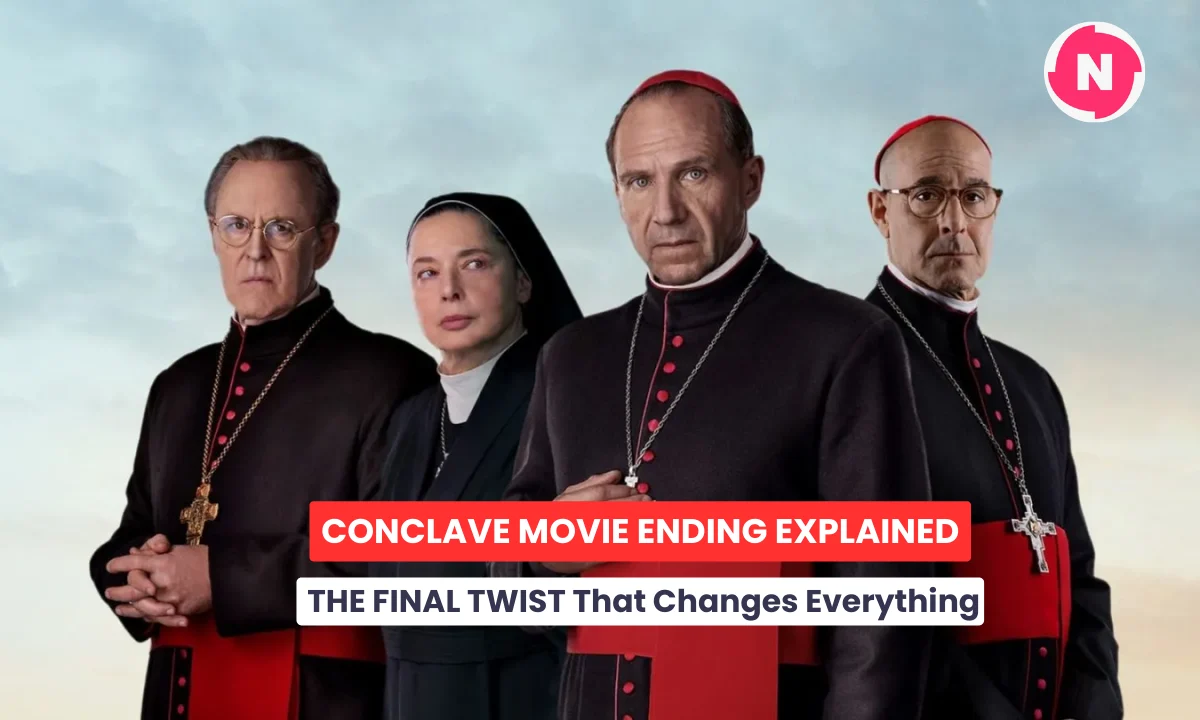
CONCLAVE MOVIE ENDING EXPLAINED: THE FINAL TWIST That Changes Everything
CONCLAVE MOVIE ENDING EXPLAINED: THE FINAL TWIST That Changes Everything
The Conclave movie ending explained discussion has become one of the most searched topics after viewers reached the final moments of this intense political thriller. The film slowly builds tension inside the Vatican and then delivers a quiet but powerful conclusion that redefines leadership faith and acceptance. Instead of relying on spectacle the ending asks deeper questions about certainty morality and who gets to hold power inside long standing institutions.
What makes the ending of Conclave so compelling is that it does not offer simple answers. It closes the election process but opens a wider conversation about identity tradition and the future of the Catholic Church. The final reveal feels surprising yet carefully prepared making many viewers revisit earlier scenes with new understanding.
KEY TAKEAWAYS
- Cardinal Vincent Benitez is elected Pope in an unexpected outcome
- The final twist reveals Benitez was born intersex and chose acceptance over secrecy
- Cardinal Lawrence learns that moral purity does not always mean perfection
- The ending focuses on symbolism rather than public revelation
- The film closes on hope uncertainty and quiet reform rather than certainty
THE CONTEXT LEADING TO THE FINAL VOTE
Conclave begins with the death of the Pope and the immediate responsibility placed on Cardinal Thomas Lawrence to oversee the election. The process unfolds behind locked doors with political maneuvering hidden rivalries and moral conflicts slowly coming to the surface. Several strong candidates emerge each representing a different ideological direction for the Church.
As Lawrence investigates the background of each frontrunner he uncovers secrets that complicate the idea of moral authority. These discoveries remove leading candidates one by one and shift the tone of the conclave from certainty to doubt. By the time voting reaches its final stage the audience understands that the decision will not simply be about popularity or power.
WHO BECOMES THE NEW POPE AND WHY IT MATTERS
The election of Cardinal Vincent Benitez comes as a shock within the story and for viewers watching the film. He is not positioned early as a frontrunner and arrives late to the conclave. Yet his calm presence lack of ambition and clear moral grounding slowly set him apart.
Benitez represents a figure untouched by corruption not because he is flawless but because he is sincere. The votes swing in his favor when other candidates are disqualified by their own compromises. His selection signals a break from political calculation and toward spiritual humility.
THE FINAL TWIST EXPLAINED IN SIMPLE TERMS
After the election Lawrence discovers a deeply personal truth about Benitez. He was born intersex and learned this only later in life during a medical procedure. For years he believed this fact disqualified him from priesthood. The late Pope however accepted him fully and protected this knowledge.
Benitez chose not to alter his body because he believed changing it would reject how he was created. This choice becomes central to the film’s message. His difference is not presented as scandal but as a quiet strength shaped by lived understanding and compassion.
This revelation is not shared with the other cardinals or the public. The Church announces a new Pope without disclosing his personal history. The film leaves viewers with an unresolved but intentional silence.
WHY CARDINAL LAWRENCE KEEPS THE SECRET
Throughout the movie Lawrence exposes wrongdoing whenever it threatens the integrity of the conclave. His decision to protect Benitez’s secret may appear contradictory at first. The difference lies in intent and harm.
The secrets Lawrence reveals involve manipulation abuse or corruption. Benitez’s truth involves identity and personal dignity. Revealing it would not correct wrongdoing. It would only cause harm. Lawrence understands that leadership does not require total exposure. It requires wisdom about when silence is more ethical than disclosure.
THE SYMBOLISM OF THE FINAL SCENES
The closing scenes are filled with subtle imagery. The burning of ballots signifies the end of division and the beginning of unity. The white smoke is not shown directly shifting focus from tradition to internal change.
Lawrence opens a window and light enters the room for the first time. Laughter from nuns outside breaks the heavy silence that dominated the film. These moments suggest renewal openness and the presence of voices long excluded from power.
Animals such as turtles appear earlier and again near the end symbolizing patience resilience and survival across environments. This mirrors Benitez’s own existence between rigid categories and lived reality.
WHAT THE ENDING IS REALLY SAYING
The Conclave ending is not about shock value. It is about redefining what holiness leadership and faith look like in a complex world. The film argues that certainty is not the foundation of belief. Humility is.
By electing a Pope who exists outside traditional definitions the story suggests that institutions evolve not by force but by conscience. The ending does not promise transformation. It suggests possibility.
PUBLIC OPINION AND VIEWER RESPONSE
Public reactions online show a clear pattern. Many viewers describe the ending as emotionally heavy but meaningful. The quiet final moments resonate more than dramatic confrontation. Audiences appreciate how the film avoids clear moral victory and instead leans into reflection.
Some viewers feel the ending is restrained after such intense buildup. Others argue that restraint is the point. The lack of public revelation mirrors real institutional change which often happens slowly and invisibly.
Overall discussion frames the ending as tragic hopeful and unsettling in equal measure. That balance is why the film continues to spark debate long after the credits roll.
FINAL THOUGHTS ON THE CONCLAVE ENDING
The ending of Conclave works because it respects the audience. It does not explain everything or resolve every question. It trusts viewers to sit with uncertainty and consider what leadership means beyond rules and appearances.
Rather than presenting reform as loud or immediate the film shows it as quiet internal and fragile. The final image is not about power. It is about openness. That choice is what gives the ending its lasting impact.
Tags: Conclave movie ending, Conclave explained, Conclave final twist, Vatican political thriller, Conclave symbolism, Cardinal Benitez, papal election film
Related Posts :



Share This Post