What Is The 2 Minute Rule For ADHD: 7 Note Taking Methods And Study Principles That Actually Work

What Is The 2 Minute Rule For ADHD: 7 Note Taking Methods And Study Principles That Actually Work
It is 11 PM. Your exam is tomorrow morning. Your desk is covered in loose papers, half filled notebooks, sticky notes that made sense three days ago, and a laptop with fifteen tabs open. You scroll. You reread the same sentence four times. You highlight something. You check your phone. You feel the pressure rising in your chest.
You are not lazy. You are not careless. You are not incapable.
If you have ADHD, the hardest part of studying is often not understanding the material. It is starting in the first place.
The 2 Minute Rule for ADHD is a simple but powerful strategy designed to break that invisible wall. Instead of forcing yourself into a long, perfect study session, you commit to starting for just two minutes. You are not trying to finish. You are not trying to master the chapter. You are simply trying to begin.
Most productivity systems were built for neurotypical brains. They assume consistent motivation, stable dopamine levels, and reliable executive function. ADHD brains operate differently. Executive dysfunction, working memory overload, emotional resistance, and inconsistent focus make traditional advice like “just sit down and do it” feel impossible.
In this comprehensive guide, you will learn:
- What the original 2 Minute Rule is and why it needs adaptation for ADHD
- Why ADHD brains resist note taking and studying
- The ADHD friendly Two Minute Launch Rule
- 7 powerful note taking methods and study principles tailored for ADHD
- Exact two minute starter actions for each method
- Templates and structural ideas you can copy immediately
- A practical weekly system that combines everything into one workflow
- Common ADHD pitfalls and how the 2 Minute Rule prevents them
- A 30 day implementation challenge to build momentum
This is not generic productivity advice. This is a practical, integrated system designed for real ADHD brains in real study environments.
Key Takeaways
- The ADHD version of the 2 Minute Rule focuses on starting, not finishing
- Starting lowers activation energy and reduces emotional resistance
- Structured note systems reduce cognitive overload
- Active recall methods outperform passive rereading
- Visual and non linear formats support ADHD thinking
- Digital hybrid tools can reduce friction and improve flexibility
- Consistent short reviews beat long cramming sessions
- Two minutes can unlock thirty
Understanding The 2 Minute Rule For ADHD
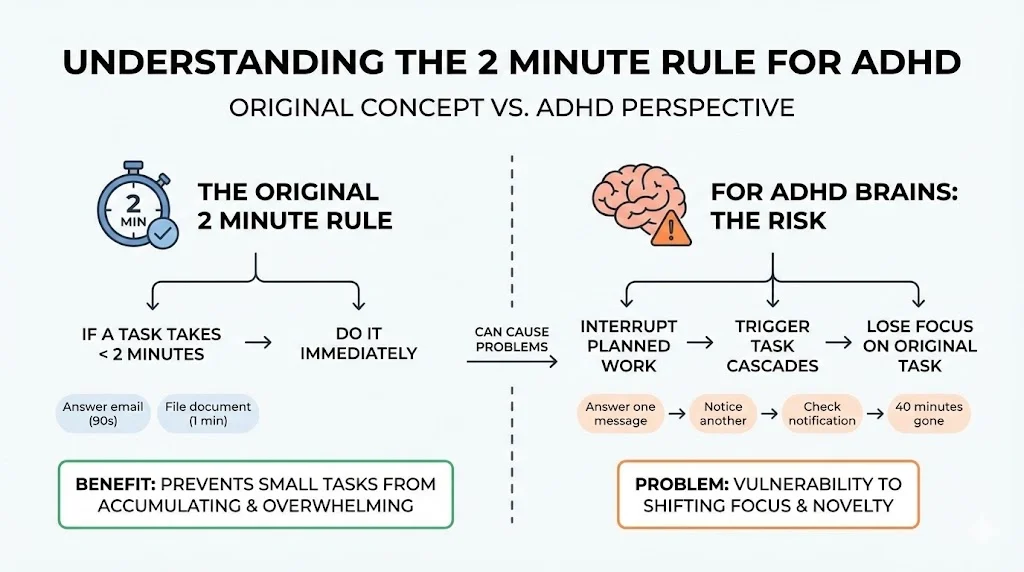
The original 2 Minute Rule comes from David Allen, the creator of Getting Things Done. His version states: If a task takes less than two minutes, do it immediately.
The purpose is to prevent small tasks from accumulating and overwhelming your to do list. If answering an email takes ninety seconds, do it now. If filing a document takes a minute, handle it.
For many people, this works beautifully. For ADHD brains, it can cause problems.
When you interrupt a planned study block to clear small tasks, you risk triggering what many people with ADHD experience as task cascades. You answer one message. Then you notice another. Then you check a notification. Suddenly, forty minutes are gone and your original task has not even started.
The problem is not the rule itself. The problem is how ADHD brains respond to shifting focus and novelty.
Also Read: Best AI Note Taking App For Students And Meetings: Top Picks For Android And iPhone In 2026
The ADHD Adapted Version: The Two Minute Launch Rule
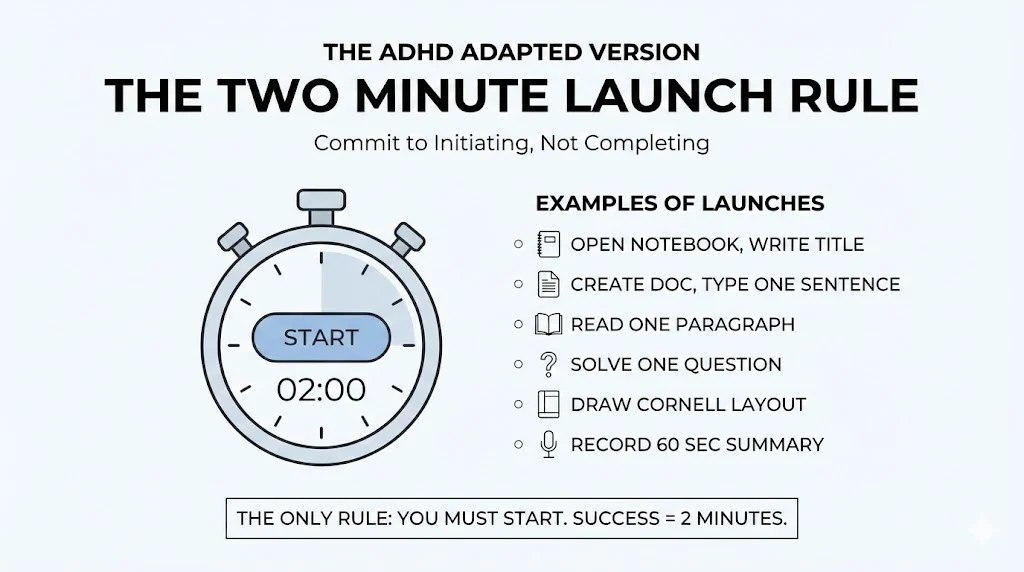
Instead of finishing tasks under two minutes, the ADHD version focuses on starting larger tasks for two minutes.
You are not promising to complete anything.
You are committing to initiating.
Examples:
- Open your notebook and write the chapter title
- Create a blank document and type one sentence
- Read one paragraph of your textbook
- Solve one practice question
- Draw the layout of your Cornell notes page
- Record a 60 second voice summary
The only rule is that you must start.
After two minutes, you are allowed to stop. If you continue, that is a bonus. If you stop, you still succeeded.
Why This Works Neurologically
ADHD is closely tied to dopamine regulation. Dopamine is not just about pleasure. It is about motivation, anticipation, and perceived reward.
When a task feels large, undefined, or overwhelming, the brain does not anticipate reward. It anticipates effort. That lowers motivation before you even begin.
The Two Minute Launch Rule reduces perceived effort. It shrinks the task to a size your brain does not perceive as threatening.
Psychologically, it works because:
- It reduces activation energy
- It removes performance pressure
- It bypasses perfectionism
- It creates immediate visible progress
- It interrupts avoidance loops
When you start, even in a tiny way, your brain receives a small progress signal. That progress often increases dopamine just enough to keep going.
You move from resistance to motion.
ADHD Adapted Version Vs Standard Version
| Feature | Standard Rule | ADHD Adapted Version |
|---|---|---|
| Focus | Finish small tasks | Start larger tasks |
| Risk | Interrupts flow | Protects deep work |
| Goal | Clear quick tasks | Build momentum |
| Best For | Email, admin | Studying, essays, projects |
The key difference is intention.
The standard version clears clutter.
The ADHD version builds momentum.
When studying, momentum is everything.
Why ADHD Brains Struggle With Note Taking?
Before we jump into methods, it is important to understand the deeper problem.
Note taking sounds simple. Sit down. Listen. Write.
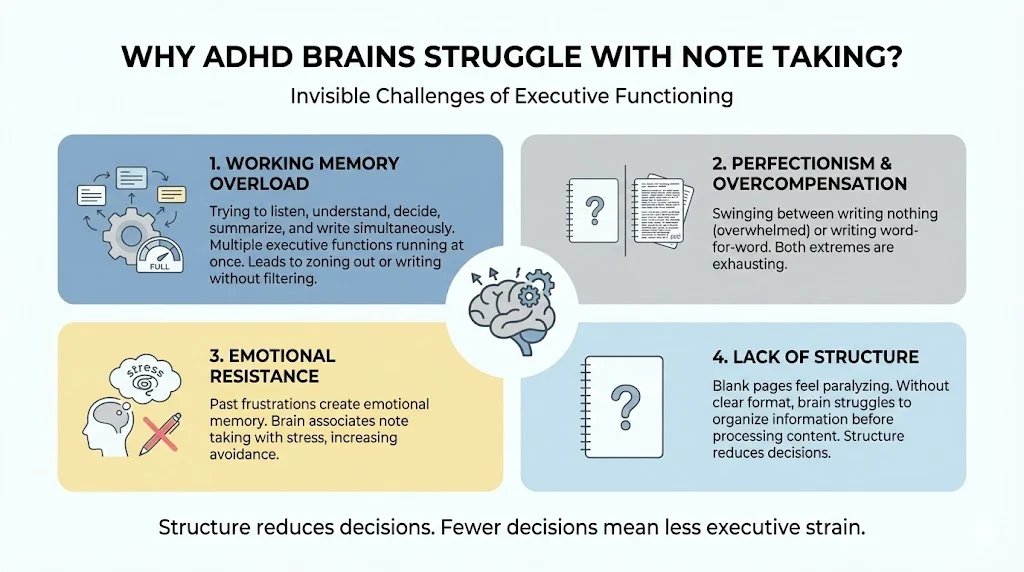
For ADHD brains, several invisible challenges occur at once:
1. Working Memory Overload
You are trying to listen, understand, decide what matters, summarize it, and write it down at the same time. That is multiple executive functions running simultaneously.
When working memory overloads, you either zone out or write everything without filtering.
2. Perfectionism And Overcompensation
Many ADHD students swing between two extremes:
- Writing nothing because it feels overwhelming
- Writing everything word for word
Both are exhausting.
3. Emotional Resistance
If past study attempts ended in frustration, your brain associates note taking with stress. That emotional memory increases avoidance.
4. Lack Of Structure
Blank pages can feel paralyzing. Without a clear format, your brain must decide how to organize information before it even begins processing content.
Structure reduces decisions. Fewer decisions mean less executive strain. That is why combining the Two Minute Launch Rule with structured note taking systems works so well.
The 7 Note Taking Methods And Study Principles That Actually Work
Each method below includes:
How it works
Why ADHD brains benefit
Your exact 2 Minute starter
When to use it
How to integrate review
1. The Cornell Method And The 5 R’s
Developed by Walter Pauk at Cornell University, the Cornell Method divides your page into three sections:
- Main note area on the right
- Cue column on the left
- Summary section at the bottom
It pairs with the 5 R’s:
- Record
- Reduce
- Recite
- Reflect
- Review
Why ADHD Brains Benefit
The Cornell structure reduces decision fatigue. You do not have to invent a layout. The cue column encourages active recall rather than passive rereading. The summary section forces processing, which strengthens memory encoding.
It transforms chaotic notes into an organized system.
2 Minute Starter
Draw the vertical line to create the cue column. Write the date and topic at the top.
That is it.
If momentum builds, write three bullet points from memory before even opening your book.
When To Use It
- Structured lectures
- University courses
- Exam heavy subjects
- Any material that requires recall
Review Integration
Within 24 hours, cover the main note section and try to answer questions from the cue column. This activates retrieval pathways and strengthens retention.
2. Mind Mapping
Mind mapping uses a central concept with branches extending outward. It mirrors associative thinking.
Why ADHD Brains Benefit
ADHD thinking is often non linear. Ideas connect in webs rather than straight lines. Mind maps allow freedom while still creating structure.
They are visually stimulating. Color and spatial layout help memory encoding.
2 Minute Starter
Draw a circle in the center. Write the topic. Add one branch only.
Stop if you want.
When To Use It
- Concept heavy subjects
- Essay planning
- Reviewing chapters
- Brainstorming
Review Integration
Use a different color to add connections during review sessions. Expanding the map reinforces associations.
3. SQ3R Method For Active Reading
Created by Francis P. Robinson, SQ3R stands for:
- Survey
- Question
- Read
- Recite
- Review
Why ADHD Brains Benefit
Passive reading causes mind wandering. SQ3R forces engagement and intention.
Turning headings into questions creates a goal. Goals increase focus.
2 Minute Starter
Survey only. Flip through the chapter. Read headings and subheadings. Look at images and summaries.
Do not read deeply.
When To Use It
- Textbooks
- Research articles
- Dense academic material
Review Integration
After reading, close the book and recite the main points out loud. Speaking activates different neural pathways than silent reading.
4. Outline Method
The outline method uses indentation to show hierarchy.
Main Topic
Subtopic
Supporting Detail
Why ADHD Brains Benefit
Hierarchy clarifies relationships between ideas. It prevents scattered note taking. It makes scanning easier before exams.
2 Minute Starter
Write only the main headings from your lecture slides.
When To Use It
- History
- Law
- Theoretical subjects
- Structured presentations
Review Integration
Condense each main heading into one summary sentence during review.
5. Charting Or Matrix Method
This method organizes information into comparison tables.
Why ADHD Brains Benefit
Tables reduce paragraph overload. They visually highlight differences and similarities. This supports pattern recognition.
2 Minute Starter
Draw the table grid. Label the columns.
When To Use It
- Comparing theories
- Historical periods
- Biological systems
- Psychological models
Review Integration
Cover one column and attempt to recall details before checking.
6. Feynman Technique
Popularized by Richard Feynman, this technique requires explaining a concept in simple language.
Why ADHD Brains Benefit
Explaining forces clarity. If you cannot simplify it, you do not fully understand it.
Active explanation prevents passive illusion of competence.
2 Minute Starter
Write one sentence explaining the concept as if teaching a child.
When To Use It
- After studying
- Before exams
- When confused
Review Integration
Identify gaps in your explanation. Return to notes only to fill those gaps.
7. Digital Hybrid Method
Digital tools can reduce friction and increase flexibility. Instead of rewriting messy notes, you can reorganize instantly.
Popular tools include:
- Notion
- Obsidian
Why ADHD Brains Benefit
- Searchable notes
- Easy restructuring
- Linking ideas visually
- Voice recording reduces pressure
2 Minute Starter
Open the app. Create one page with today’s topic. Type three bullet points from memory.
Or record a 60 second summary before writing anything.
When To Use It
- University lectures
- Research heavy programs
- Long term knowledge building
Review Integration
Use backlinks or tags to connect related topics weekly.
How To Combine Everything Into One ADHD Study System
A system prevents decision fatigue. Here is a simple framework.
Step 1: Preparation
- Clear visible clutter
- Keep one notebook or one tab open
- Set a 15 minute timer
- Choose your method in advance
Step 2: Two Minute Launch
Start with the smallest possible action. Draw the template. Write the title. Survey the chapter.
Step 3: Capture Without Perfection
Use bullet points. Abbreviations. Symbols. Avoid full sentences unless necessary.
Focus on ideas, not wording.
Step 4: Immediate Micro Review
Spend 2 to 5 minutes reviewing what you wrote before ending the session.
Step 5: Weekly Structured Review
Choose one day for active recall using cue columns, mind map expansion, or Feynman explanations.
Practical Weekly Study Framework
| Day | Focus Strategy | Time |
|---|---|---|
| Monday | SQ3R Reading | 25 mins |
| Tuesday | Cornell Notes + Recite | 30 mins |
| Wednesday | Mind Map Expansion | 20 mins |
| Thursday | Feynman Explanation Practice | 25 mins |
| Friday | Chart Creation Or Comparison | 20 mins |
| Weekend | Weekly Review + 2 Min Launch | 30 mins |
You can rotate methods based on subjects. The key is consistency.
Common ADHD Pitfalls And How The 2 Minute Rule Fixes Them
Perfectionism
Problem: Waiting until you feel ready.
Fix: Two minute starters eliminate readiness requirement.
Hyperfocus On Formatting
Problem: Spending an hour choosing colors.
Fix: Set a timer before adjusting layout.
Avoidance After Missing One Day
Problem: All or nothing thinking.
Fix: Restart with two minutes the next day.
Overloading With Too Many Tools
Problem: Switching apps constantly.
Fix: One core method per subject.
30 Day Two Minute Implementation Challenge
For the next 30 days:
- Start one academic task daily for two minutes
- Track whether you continued
- Record your emotional state before and after
At the end of 30 days, review patterns.
Most people discover that once they cross the starting line, continuing becomes easier.
Final Thoughts
The 2 Minute Rule for ADHD is not about willpower. It is about friction reduction and neurological alignment. When you shrink the starting point, your brain stops resisting.
Combine the Two Minute Launch Rule with structured note taking systems like Cornell, SQ3R, mind mapping, charting, outlines, Feynman explanations, and digital hybrids. Add short reviews. Keep systems simple.
Two minutes feels small. But it breaks paralysis. And once you move, momentum does the rest.
Related Posts :





Share This Post