JEE Mains Response Sheet 2026: Session 1 Answer Review, Objection Window, And What Students Should Do Next
JEE Mains Response Sheet 2026: Session 1 Answer Review, Objection Window, And What Students Should Do Next
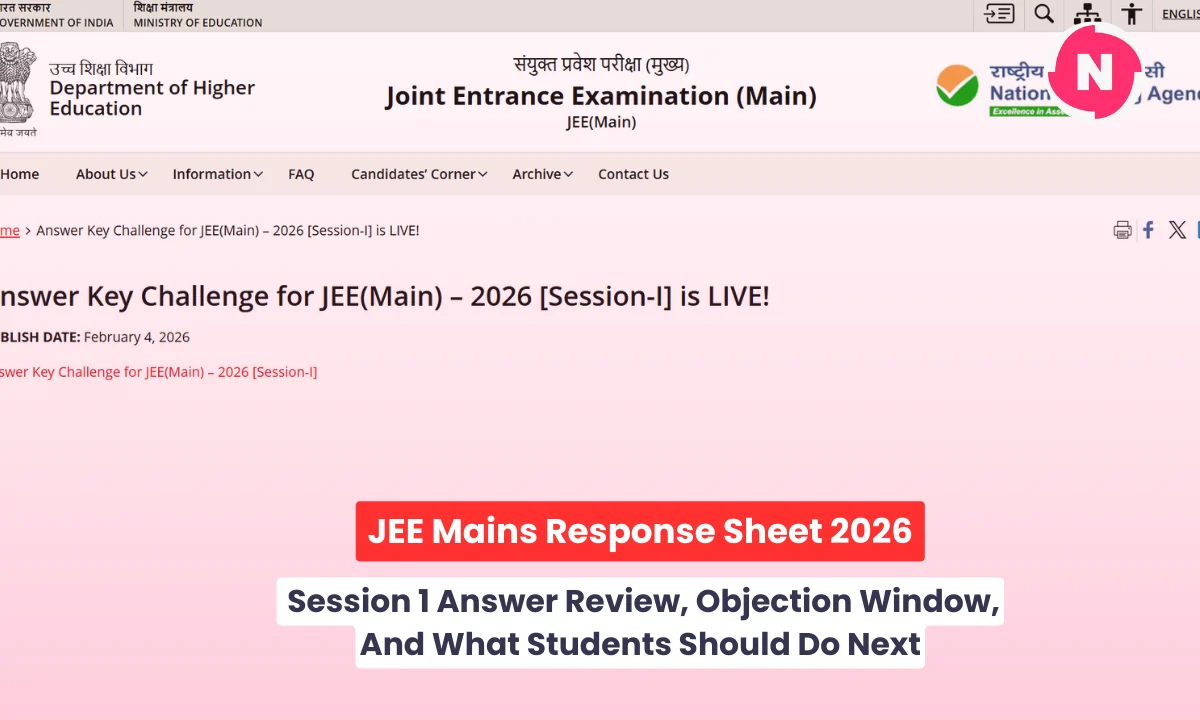
The JEE Mains Response Sheet 2026 for Session 1 has been released, bringing a crucial phase for engineering aspirants who appeared in the January examination.
The response sheet is now available through candidate login and allows students to review the answers they marked during the exam and compare them with the provisional answer key. This step plays an important role in helping candidates understand their performance and prepare for the next stage of the admission process.
For many students, the release of the JEE Mains Response Sheet 2026 marks the first clear opportunity to estimate scores using the official marking scheme. It also opens a short window to raise objections against the provisional answer key in case of discrepancies. With limited time available for challenges, candidates are expected to act carefully and promptly.
Key Takeaways
- JEE Mains Response Sheet 2026 Session 1 has been released online for candidates.
- The provisional answer key and question papers are available with the response sheet.
- Candidates can calculate tentative scores using the official marking scheme.
- The objection window is open for a limited period with a per question fee.
- Final answer key and results are expected around mid February 2026.
WHAT IS JEE MAINS RESPONSE SHEET 2026 AND WHY IT MATTERS
The JEE Mains Response Sheet 2026 is a digital copy of the answers marked by a candidate during the computer based test. It shows each question along with the option selected, unanswered questions, and marked for review status. This document is important because it reflects exactly what was submitted during the exam.
By comparing the response sheet with the provisional answer key, candidates can estimate their expected score before the official result is declared. This helps in setting realistic expectations for percentile and rank. It also allows students to identify potential errors in the answer key and decide whether raising an objection is necessary.
HOW TO ACCESS THE JEE MAINS RESPONSE SHEET 2026
Candidates can access the JEE Mains Response Sheet 2026 through the official examination portal using their application number and password. Once logged in, the response sheet along with the provisional answer key and question paper becomes visible on the dashboard.
It is advised to download and save a copy of the response sheet for future reference. Many students prefer to take screenshots or keep printed copies while calculating scores to avoid repeated logins during peak traffic hours.
DETAILS MENTIONED ON THE RESPONSE SHEET
The response sheet contains several important details that candidates should verify carefully. These details help in matching answers accurately and ensuring that the sheet belongs to the correct candidate.
| Information Included | Description |
|---|---|
| Application Number | Unique registration number of the candidate |
| Candidate Name | Name as registered for the exam |
| Roll Number | Examination roll number |
| Exam Date And Shift | Date and timing of the test |
| Subject Wise Questions | Physics, Chemistry, Mathematics |
| Question ID And Options | Official question reference |
| Candidate Response | Option selected during the exam |
| Status | Answered, unanswered, or marked for review |
Any mismatch in these details should be noted immediately, as they form the basis for score calculation and result preparation.
JEE MAINS 2026 MARKING SCHEME EXPLAINED
To calculate the tentative score using the JEE Mains Response Sheet 2026, candidates must follow the official marking scheme released along with the answer key. The marking pattern remains consistent across sessions.
- Correct answer awards four marks.
- Incorrect answer results in a deduction of one mark.
- Unattempted questions carry zero marks.
- Dropped questions result in full marks for all candidates of that shift.
Using this method, students can calculate subject wise and overall scores. This exercise helps in understanding the performance level and comparing it with expected cut offs from previous years.
OBJECTION WINDOW AND ANSWER KEY CHALLENGE PROCESS
One of the key purposes of releasing the JEE Mains Response Sheet 2026 is to allow candidates to challenge the provisional answer key if required. The objection window is open for a limited period and requires careful evaluation before submission.
Candidates need to select the question they wish to challenge and upload supporting academic proof. A processing fee is charged for each question challenged. If the challenge is found valid, the fee is adjusted as per official norms and the answer key is revised for all candidates.
It is important to note that individual responses are not challenged. Only the provisional answer key can be questioned. Once all objections are reviewed, a final answer key is published, which becomes the basis for result calculation.
IMPORTANT DATES RELATED TO JEE MAINS RESPONSE SHEET 2026
Understanding the timeline helps candidates plan their next steps effectively. Below is a summary of the key events related to Session 1.
| Event | Date |
|---|---|
| Session 1 Exam Dates | January 21 to January 29 2026 |
| Response Sheet Release | February 4 2026 |
| Answer Key Objection Window | February 4 to February 6 2026 |
| Final Answer Key | Expected before result |
| Session 1 Result | Around February 12 2026 |
Candidates should keep checking official updates during this period to avoid missing any deadlines.
PUBLIC OPINION AND STUDENT REACTIONS
Public reaction to the release of the JEE Mains Response Sheet 2026 has been widely discussed on social platforms and student forums. Many students have expressed relief after being able to finally check their marked responses and calculate scores after weeks of uncertainty.
There is appreciation for the timely release of the response sheet and answer key, which students feel adds transparency to the evaluation process. Several posts highlight how past objections have led to corrections and benefited candidates, increasing confidence in the system.
At the same time, concerns have been raised about the short objection window. Some candidates reported login delays during peak hours, while others felt the time provided to analyze questions was limited. Despite this, the overall tone remains proactive, with students encouraging peers to review answers carefully and act within deadlines.
WHAT TO DO AFTER CHECKING THE RESPONSE SHEET
After reviewing the JEE Mains Response Sheet 2026, candidates should focus on a few practical next steps. First, ensure that the score calculation is done accurately using the marking scheme. Second, identify only those questions for objection where strong academic justification exists.
Students who are satisfied with their performance often begin planning for Session 2 or focusing on JEE Advanced preparation. Those aiming to improve scores may analyze weak areas and adjust study strategies accordingly. The response sheet serves as a valuable feedback tool in this process.
FINAL ANSWER KEY AND RESULT EXPECTATIONS
Once the objection window closes, the final answer key is prepared after expert review. This version is considered definitive and is used to compile results. No further changes are made after this stage.
The JEE Mains Session 1 result is expected to be announced shortly after the final answer key. Candidates are advised to rely only on official portals for updates and avoid unverified information circulating online.
CONCLUSION
The release of the JEE Mains Response Sheet 2026 marks an important checkpoint in the examination cycle. It empowers candidates to understand their performance, ensures transparency in evaluation, and provides a fair opportunity to raise valid concerns.
While the process comes with pressure due to tight timelines, careful review and informed decision making can help candidates make the most of this phase. Staying calm, organized, and attentive to official instructions remains the best approach during this period.
w JEE Mains Response Sheet 2026, JEE Main Answer Key 2026, JEE Main Session 1, NTA JEE Updates, JEE Main Objection Window, JEE Result 2026
Related Posts :


Share This Post