Kamal Haasan Rajya Sabha Speech: Living Dead Voters Warning Sparks Nationwide Debate
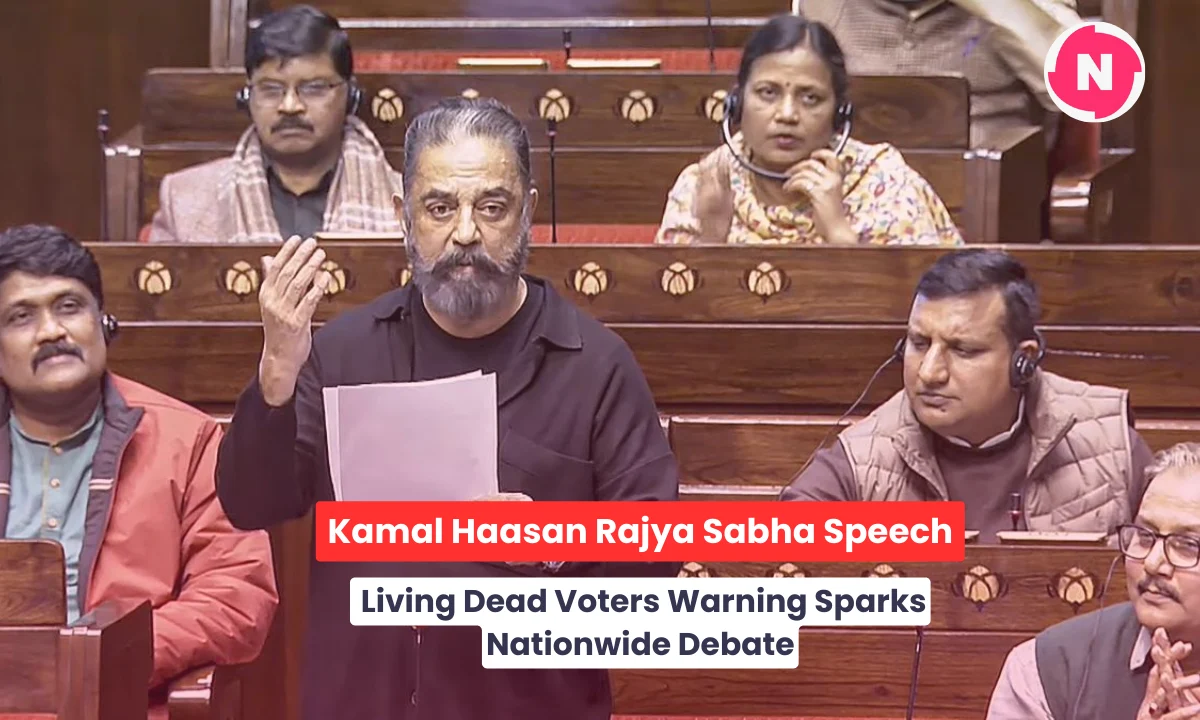
Kamal Haasan Rajya Sabha Speech: Living Dead Voters Warning Sparks Nationwide Debate
Kamal Haasan made a strong and widely discussed entry into parliamentary debate with his maiden speech in the Rajya Sabha, placing electoral integrity and democratic responsibility at the center of national attention.
Speaking during the Motion of Thanks to the President’s address in the Budget Session, he raised concerns over the Special Intensive Revision of electoral rolls, commonly referred to as SIR, and warned that flawed implementation could quietly erase the voting rights of millions.
The speech has resonated far beyond the House. From Tamil Nadu to the national capital, discussions around voter disenfranchisement, language dignity, and democratic impermanence have intensified.
His remarks were not framed as partisan criticism. Instead, they reflected a broader anxiety about administrative systems overpowering citizen rights, especially in a diverse and populous democracy like India.
KEY TAKEAWAYS
- Kamal Haasan warned that SIR errors could turn nearly one crore voters into “living dead on paper”
- He cited Bihar as a real-world example of voter list errors during revision
- The speech stressed that democracy depends on protecting ordinary citizens’ voting rights
- His remarks on Tamil language dignity gained wide cultural support
- Public response on X and other platforms has been largely positive and admiring
CONCERNS OVER SPECIAL INTENSIVE REVISION OF ELECTORAL ROLLS
In his address, Kamal Haasan focused sharply on how the Special Intensive Revision process, if executed without care, can produce irreversible consequences for voters. He pointed to instances where eligible citizens were removed from electoral rolls due to spelling errors, address mismatches, or clerical mistakes that voters themselves did not create.
Referring to past roll revisions in Bihar, he described a situation where living individuals were officially marked as deceased or absent, effectively silencing their vote. His use of the phrase “living dead on paper” struck a chord because it simplified a complex administrative failure into a human reality. The concern was not hypothetical. It was grounded in documented cases that had already occurred.
WHY BIHAR WAS CITED AS A WARNING SIGN
Bihar featured prominently in the speech as an example of how voter list revisions can go wrong when rigid verification systems collide with social realities. Kamal Haasan explained that India’s linguistic diversity, migration patterns, and documentation gaps make strict spelling or address-based verification risky.
In many reported cases, minor discrepancies were enough to disqualify voters. These were not fraudulent entries. They were citizens who had voted for years. By highlighting Bihar, he warned that Tamil Nadu or any other state could face similar consequences if the same framework is applied without safeguards.

ESTIMATED IMPACT ON TAMIL NADU VOTERS
One of the most discussed lines from the speech was the estimate that nearly one crore voters in Tamil Nadu could be affected if similar errors occur during roll revisions. While the number was presented as a warning rather than a prediction, it underscored the scale of the issue.
Tamil Nadu has high voter participation and strong political awareness. Even a small percentage of wrongful deletions could impact democratic outcomes. By raising this estimate in Parliament, Kamal Haasan framed the issue as urgent rather than procedural.
| State Context | Risk Highlighted | Possible Outcome |
|---|---|---|
| Bihar | Rigid verification errors | Eligible voters removed |
| Tamil Nadu | Large voter base | Mass disenfranchisement risk |
| National Level | Replication of SIR model | Trust erosion in elections |
DEMOCRACY AND THE IDEA THAT POWER IS NOT IMMORTAL
Beyond administrative critique, the speech carried a philosophical tone. Kamal Haasan reminded the House that no government is permanent and no authority is immune to accountability. This line was widely shared across social platforms, often quoted as a reminder of democratic balance.
His argument was simple. Systems must serve citizens because political power is temporary. When systems forget this, democracy weakens quietly rather than collapsing loudly.

CULTURAL CONTEXT AND DEFENSE OF TAMIL LANGUAGE
Another segment that received strong public attention was his response to recent remarks perceived as diminishing the Tamil language. Without naming individuals, he asserted that Tamil would not beg or steal, framing linguistic pride as dignified rather than aggressive.
He emphasized loving languages without hostility. This approach appealed to many who saw it as firm yet non-toxic. The statement connected cultural identity with democratic respect, reinforcing the idea that language and voting rights are both expressions of dignity.
CINEMA, POLITICS, AND INFLUENCES THAT SHAPED HIS VIEW
Kamal Haasan also spoke about the influences that shaped his thinking, including Mahatma Gandhi’s emphasis on non-anger, Periyar’s focus on rational thought, and C N Annadurai’s understanding of parliamentary democracy. He described cinema as a medium that taught him how stories reflect social responsibility.
This blending of cultural experience with political thought reinforced his image as someone entering politics with ideas rather than ambition alone. Many commentators noted that this approach differentiated him from conventional celebrity politicians.
PUBLIC OPINION AND ONLINE REACTION
Public reaction on X and other platforms has been largely positive. Many users praised the clarity and delivery of the speech, calling it articulate and impactful. Clips from the Rajya Sabha session circulated widely, with viewers encouraging others to watch the full address rather than isolated quotes.
Several posts admired his willingness to challenge administrative systems without personal attacks. Others highlighted his humility, especially when he referred to himself as a high school dropout, which many interpreted as honesty rather than self-deprecation.
There was mild skepticism from a smaller section questioning his political experience. However, even critical voices acknowledged that the speech raised a legitimate issue that deserves attention.
WHAT THIS MEANS FOR INDIAN ELECTORAL DISCOURSE
The larger significance of the speech lies in how it reframed voter list revisions as a citizen rights issue rather than a technical process. By bringing human consequences into parliamentary debate, Kamal Haasan shifted the focus from procedures to people.
As India approaches future elections, discussions around electoral rolls, verification, and inclusion are likely to intensify. His intervention has added urgency to ensuring that accuracy does not come at the cost of participation.
A STRONG PARLIAMENTARY DEBUT WITH LASTING IMPACT
For a first major speech in Parliament, the address has left a strong imprint. It reinforced concerns already present among civil society while introducing them into mainstream political debate. Whether it leads to policy changes remains to be seen, but it has already influenced public conversation.
By combining administrative critique, cultural pride, and democratic philosophy, Kamal Haasan positioned himself as a voice focused on institutional integrity rather than short-term politics.
Tags: Kamal Haasan Rajya Sabha speech, Special Intensive Revision electoral rolls, living dead voters issue, Tamil Nadu voter rights, Indian democracy debate, Election Commission concerns, MNM politics
Related Posts :






Share This Post