INDIA Free To Buy Oil From Anyone: Russia Pushes Back On Trump’s Claim After US-India Deal
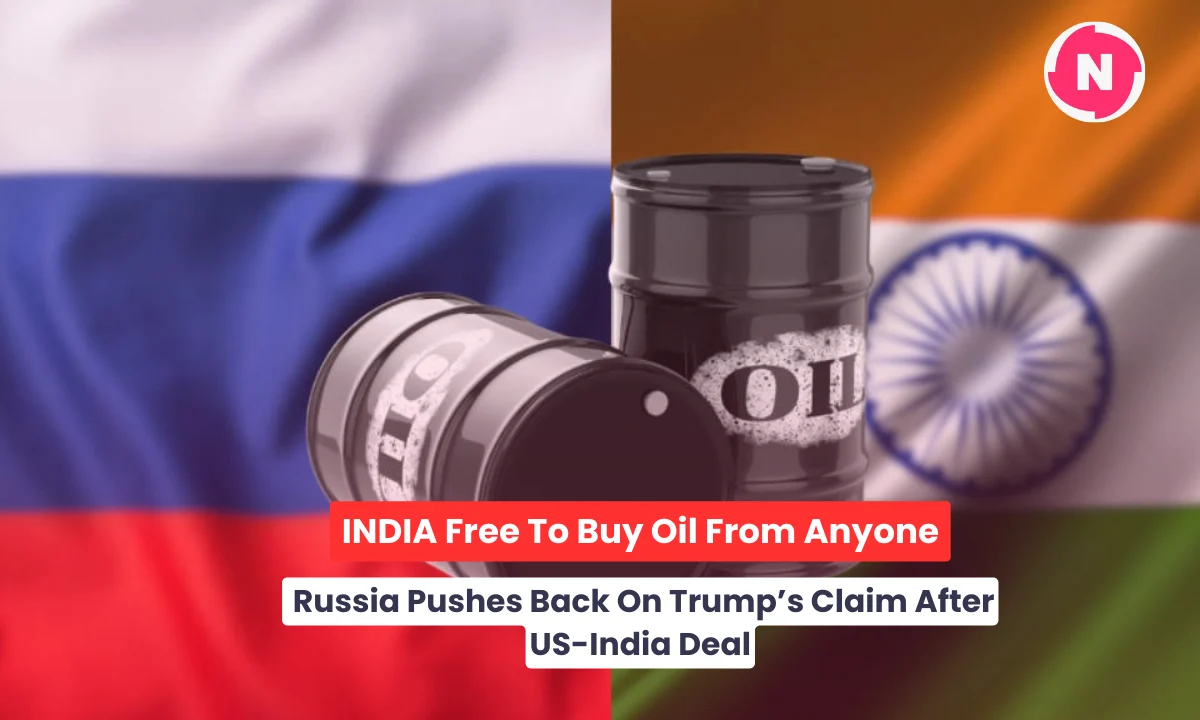
INDIA Free To Buy Oil From Anyone: Russia Pushes Back On Trump’s Claim After US-India Deal
India free to buy oil from anyone has become the center of a fresh global debate after Russia publicly responded to claims linked to the new US-India trade deal.
The discussion gained momentum after Donald Trump stated that India agreed to stop buying Russian oil as part of tariff negotiations with Washington. Moscow’s response was swift and clear. India has always sourced oil from multiple suppliers and remains free to buy crude from any country based on its national interest.
The issue goes beyond one statement or one deal. It touches India’s energy security, its economic priorities, and its approach to balancing major global powers. With oil imports forming the backbone of India’s energy needs, even small shifts carry large financial and strategic implications. Russia’s remarks, India’s silence on a full stop, and divided public opinion suggest that the story is not about a sudden policy reversal but about gradual diversification under global pressure.
Key Takeaways
- Russia says India is free to buy oil from any supplier and sees nothing new in diversification
- US claims of India halting Russian oil purchases are not officially confirmed by New Delhi
- India continues to rely heavily on imports, with Russia still supplying a large share
- A full shift away from Russian oil could raise India’s annual import bill significantly
- Public opinion is split between economic pragmatism and concerns over strategic autonomy
Russia’s Response To Trump’s Claim
Russia’s position has been consistent since the US-India trade deal was announced. Kremlin spokesperson Dmitry Peskov stated that India has never depended on a single oil supplier and has always purchased crude from several countries. According to Moscow, there is nothing new in India exploring or expanding alternative sources.
Russian officials also noted that no formal communication has been received from New Delhi indicating a complete halt to Russian oil imports. This directly counters the narrative that India agreed to stop buying Russian crude as part of trade negotiations with the United States. From Russia’s perspective, diversification is normal market behavior, not a political signal.
Moscow also emphasized that energy cooperation with India remains mutually beneficial. Russian officials believe that continued engagement helps stabilize global energy markets at a time of geopolitical uncertainty and supply disruptions.
What The US-India Trade Deal Changed
The controversy began after the announcement of a new trade agreement between India and the United States. Under the deal, US tariffs on Indian goods were reportedly reduced from 50 percent to 18 percent. In return, the US administration claimed India would reduce or stop purchases of Russian oil and shift toward American and Venezuelan supplies.
While Narendra Modi welcomed the broader trade agreement, there was no public confirmation from India regarding a binding commitment on Russian oil. This gap between US claims and Indian statements has fueled speculation rather than clarity.
The deal aims to push bilateral trade toward a long-term target of $500 billion. Energy cooperation is one part of this ambition, but it is not the only lever shaping India’s trade and foreign policy decisions.
India’s Dependence On Imported Crude
India imports nearly 88 percent of its crude oil needs, making energy security a critical policy concern. Until 2021, Russian oil made up a very small fraction of India’s imports. This changed after the Ukraine conflict, when discounted Russian crude became widely available due to Western sanctions.
At its peak, Russia supplied over one third of India’s total crude imports. Volumes crossed 2 million barrels per day in mid-2025 before gradually declining. Recent data shows imports falling to around 1.1 to 1.3 million barrels per day, reflecting diversification rather than a complete exit.
Recent Trends In Indian Crude Imports
| Source Country | Approximate Share | Trend Direction |
|---|---|---|
| Russia | Over one third earlier | Gradually declining |
| UAE | Moderate | Increasing |
| Saudi Arabia | Moderate | Stable to increasing |
| United States | Smaller share | Potential growth |
| Others | Smaller | Diversifying |
This mix highlights India’s strategy of avoiding overdependence while keeping costs manageable.
Why Replacing Russian Oil Is Not Simple
One of the biggest constraints in shifting away from Russian oil lies in crude quality and refinery compatibility. Russian Urals crude is heavier and sulfur-rich, which suits many Indian refineries. US shale oil is lighter and often requires blending with other grades.
A rapid substitution would increase operational costs for refiners. Experts have warned that a full pivot could add billions of dollars annually to India’s import bill. Some estimates suggest an increase of $9 to $11 billion per year, a figure comparable to India’s federal health budget.
Higher import costs would eventually flow into fuel prices, inflation, and broader economic growth. This is why analysts believe a sudden stop is unlikely, regardless of political pressure.
Gradual Diversification Over Abrupt Change
Rather than an abrupt break, India appears to be following a gradual diversification path. Imports from the UAE and Saudi Arabia have increased, while US crude is being evaluated as a supplementary option. Russian oil remains part of the basket, though no longer as dominant as before.
This approach allows India to balance geopolitical relationships while protecting its economy from shocks. It also preserves flexibility in a volatile global energy market where prices can spike quickly due to conflicts or supply disruptions.
Russia itself has acknowledged this reality, stating that India’s sourcing strategy has always involved multiple suppliers.
Public Opinion And Political Debate In India
Public sentiment on X shows a clear divide. Supporters of diversification view the policy as pragmatic. They argue that stronger India-US ties, lower tariffs, and reduced dependency on any one supplier serve India’s long-term interests. Many see the trade deal as a boost for Indian exports and global standing.
Others express concern about strategic autonomy. Critics fear that US economic pressure could force India into concessions that limit its independent foreign policy. Some posts describe the situation as appeasement rather than partnership, questioning whether tariff reductions justify higher energy costs.
There is also skepticism toward media narratives that frame the situation as a clear win. Sarcastic reactions highlight frustration with oversimplified headlines and lack of transparency on long-term implications.
Despite differing views, many users admire India’s ability to navigate sanctions and maintain access to discounted oil through indirect channels and diversified traders. This reflects a broader belief that India is adapting rather than surrendering control.
Strategic Autonomy Versus Economic Reality
India’s traditional non-aligned stance is being tested by today’s geopolitical environment. Global supply chains, sanctions, and trade wars leave limited room for idealistic positioning. Energy security, export growth, and inflation control demand practical decisions.
The current situation suggests India is redefining strategic autonomy as flexibility rather than rigidity. Maintaining relations with Russia, expanding ties with the US, and deepening partnerships in the Middle East all serve this updated approach.
Russia’s statement that India is free to buy oil from anyone reinforces this interpretation. It frames India not as a country bound by deals but as a buyer acting in its own interest.
What To Watch Going Forward
Several factors will shape the next phase of India’s oil strategy:
- Actual import data over the next six to twelve months
- Refinery adjustments to accommodate varied crude grades
- Global oil prices and supply disruptions
- Progress toward the $500 billion India-US trade target
A complete break from Russian oil remains unlikely in the near term. A diversified portfolio with shifting proportions is a more realistic outcome.
Conclusion
The statement that India is free to buy oil from anyone captures the essence of the current debate. Despite bold claims and strong reactions, India’s energy policy appears steady rather than reactive. Russia sees nothing new in diversification. The US sees opportunity in deeper trade ties. India sees the need to balance costs, security, and diplomacy.
Rather than choosing sides, India is choosing options. That choice, more than any headline, defines its energy future.
Tags: India oil imports, India Russia oil trade, US India trade deal, energy security India, crude oil diversification, geopolitics energy, Indian refineries
Related Posts :



Share This Post