El Niño Forecast 2026: Super El Niño Alert Raises Big Questions For India Monsoon And Global Weather
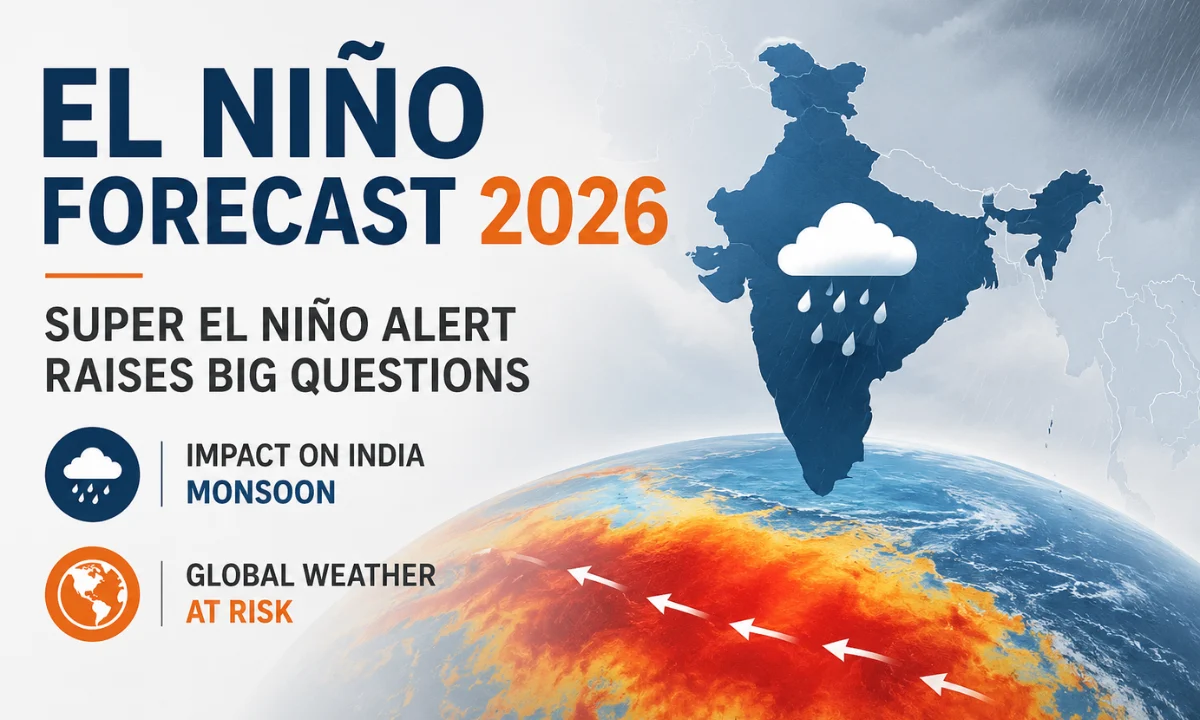
El Niño Forecast 2026: Super El Niño Alert Raises Big Questions For India Monsoon And Global Weather
The global weather system is changing fast and the latest El Niño forecast is getting serious attention from climate scientists across the world. After months of neutral conditions, the Pacific Ocean is now warming rapidly. NOAA, WMO and multiple international climate models are pointing toward a possible strong or even “Super El Niño” event developing in 2026.
For India, this matters a lot. El Niño is closely linked with weaker monsoon rainfall, rising temperatures and drought risks in several states. At the same time, some coastal regions may receive excess rain and flooding. Social media discussions and weather experts are already comparing this setup with the major El Niño events of 1997 and 2015.
Key Takeaways On El Niño Forecast 2026
- NOAA says El Niño has an 82% chance of developing between May and July 2026
- Forecast models show high probability of El Niño continuing into early 2027
- Some models are discussing a possible “Super El Niño”
- India may see below normal monsoon rainfall during late season months
- Heatwave and drought risks could rise in North and Central India
- Coastal Tamil Nadu and parts of South India may receive heavier rainfall
- Global temperatures may hit new records during 2026 and 2027
- Experts say uncertainty still exists because atmospheric winds remain unpredictable
What Is El Niño And Why Is Everyone Talking About It?
El Niño is a climate pattern linked to unusual warming in the equatorial Pacific Ocean. This warming changes wind circulation and affects weather patterns across many countries.
Normally, strong trade winds push warm ocean water toward Asia. During El Niño, these winds weaken. Warm water spreads eastward toward South America. That shift changes rainfall, storms, temperatures and monsoon systems worldwide.
This year the discussion is bigger because ocean temperatures are rising faster than expected. Climate agencies are seeing strong warming below the Pacific surface. That stored heat is now moving upward which increases the chance of a major El Niño event later this year. Many weather analysts on X are calling this one of the fastest transitions seen in recent years.
Why Scientists Are Still Being Careful
Even though forecasts look aggressive, scientists are still avoiding 100% confirmation of a “Super El Niño.” The reason is simple. El Niño depends on both the ocean and atmosphere working together. Ocean temperatures alone are not enough.
Experts say strong eastward wind bursts are needed to lock the warming into a self sustaining cycle. Right now that atmospheric support is not fully confirmed. Similar situations happened in 2014 and 2017 when early forecasts looked strong but conditions weakened later.
Here’s a simple breakdown:
| Forecast Factor | Current Situation |
|---|---|
| Pacific Ocean Temperature | Rapidly Warming |
| Subsurface Heat Build Up | Very Strong |
| NOAA El Niño Probability | 82% |
| Chance Through Winter 2026-27 | 96% |
| Wind Pattern Support | Still Uncertain |
| Super El Niño Discussion | Increasing |
So yes, the risk is real. But scientists still want to watch June and July carefully before making stronger claims.
Why India Is Watching This Forecast Closely
India’s economy, agriculture and water supply depend heavily on the southwest monsoon. Around 60% of Indian farming areas rely mainly on rainfall. That’s why El Niño becomes such a big concern here.
The India Meteorological Department has already indicated that the 2026 monsoon could remain below normal. Current estimates suggest rainfall may stay around 92% of the Long Period Average.
The bigger issue may appear during August and September. Early monsoon arrival does not always guarantee a strong season. In fact, many experts believe El Niño’s effect could weaken rainfall during the second half of the monsoon.
Regions That Could Face Higher Risk
Several states may experience lower rainfall and hotter conditions if El Niño strengthens.
| High Risk Regions | Possible Impact |
|---|---|
| Rajasthan | Drought and heat |
| Punjab | Weak rainfall |
| Haryana | Water stress |
| Madhya Pradesh | Rainfall deficit |
| Maharashtra | Agricultural stress |
| Delhi NCR | Extended heatwaves |
| Gujarat | Dry conditions |
At the same time, some southern and coastal areas could receive excessive rainfall.
| Regions With Flood Risk | Possible Impact |
|---|---|
| Chennai | Heavy rainfall |
| Coastal Andhra Pradesh | Flooding |
| Tamil Nadu | Strong rain events |
| Kerala | Intense early monsoon rain |
This uneven weather pattern is typical during strong El Niño years.
Can A Positive Indian Ocean Dipole Reduce The Damage?
One factor giving some hope is the possible development of a positive Indian Ocean Dipole or IOD later in the season. A positive IOD usually helps improve rainfall over India by warming the western Indian Ocean. Some climate models suggest this could partially balance El Niño’s negative impact.
Still, experts warn that the final outcome depends on timing and strength. If El Niño becomes too powerful, the positive IOD may not fully offset the rainfall loss.
Global Impact Could Be Massive
This forecast is not only about India. Strong El Niño events affect weather across the entire world. If current projections continue, 2026 and 2027 could become some of the hottest years ever recorded.
Possible global impacts include:
- Drought in Australia and Indonesia
- Flooding in Peru and Ecuador
- Increased wildfire risk in several regions
- Weaker Atlantic hurricane season
- More Pacific cyclones
- Food supply disruptions in vulnerable countries
- Rising energy demand because of extreme heat
Some researchers are even comparing this setup with the historic 1877-78 El Niño event which contributed to severe global food crises. Modern forecasting systems are far better today. Still, climate experts say governments should prepare early instead of waiting for certainty.
What People Are Saying On X And Social Media
Public discussion around the El Niño forecast is growing rapidly online. Many users are sharing NOAA graphics and model updates showing warming ocean temperatures. Posts discussing “Super El Niño” are getting strong engagement especially in India, Australia and the United States.
A lot of conversation is focused on:
- Weak monsoon fears in India
- Heatwave concerns in Delhi NCR
- Possible food inflation
- Wildfire risk globally
- Comparisons with the 2015-16 El Niño event
- Record global temperatures during 2027
Some viral posts are making extreme claims about temperature spikes and disaster scenarios. Scientists however are asking people to avoid panic and focus on preparedness instead.
Why June And July Will Be Crucial
The next few weeks are extremely important for weather experts. If atmospheric winds align with the warming Pacific waters, El Niño could strengthen rapidly by late summer. If those wind patterns fail to develop properly, the event may remain moderate.
NOAA’s next ENSO updates are expected to provide clearer signals. That is why most meteorologists are currently using balanced language. The threat is serious. But the exact intensity is still evolving.
My Final Words On El Niño
2026 El Niño forecast is rapidly transitioning from a meteorological warning into a massive macroeconomic storyline. As the Pacific Ocean warms at an unprecedented pace, the true scale of this climate event will be decided by three critical environmental factors over the next two months:
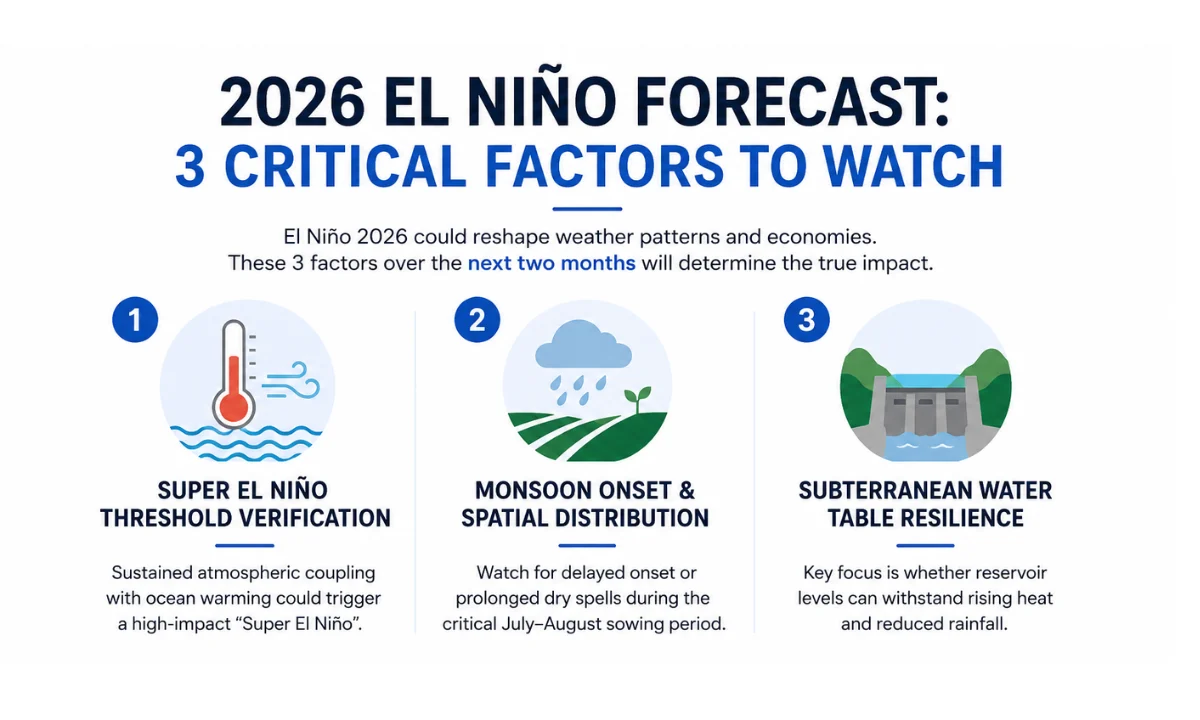
- The “Super El Niño” Threshold Verification: While sea-surface temperature anomalies are rising quickly, meteorologists are watching for sustained atmospheric coupling. If the wind patterns lock in with the ocean warming, it triggers the transition from a standard event to a high-impact “Super El Niño.”
- Monsoon Onset and Spatial Distribution: For India’s agricultural sector, the timing is everything. Close attention must be paid to whether the warming trends cause a delayed onset or create prolonged dry spells during the crucial sowing months of July and August.
- Subterranean Water Table Resilience: Local authorities and water planners are shifting focus to reservoir capacities. The critical variable is whether existing water reserves can cushion the double blow of rising heat stress and reduced seasonal rainfall.
Climate experts continue to remind us that seasonal forecasts are built on complex probabilities, not absolute guarantees the atmosphere ultimately holds the final veto.
However, for agricultural commodities traders, rural communities, and policy planners, the upcoming Pacific climate updates will remain among the most volatile and heavily scrutinized indicators shaping the domestic economic outlook throughout 2026.
Share This Post