Ankur Warikoo Course Business Closure: Why A Rs 100 Crore Business Suddenly Shut Down
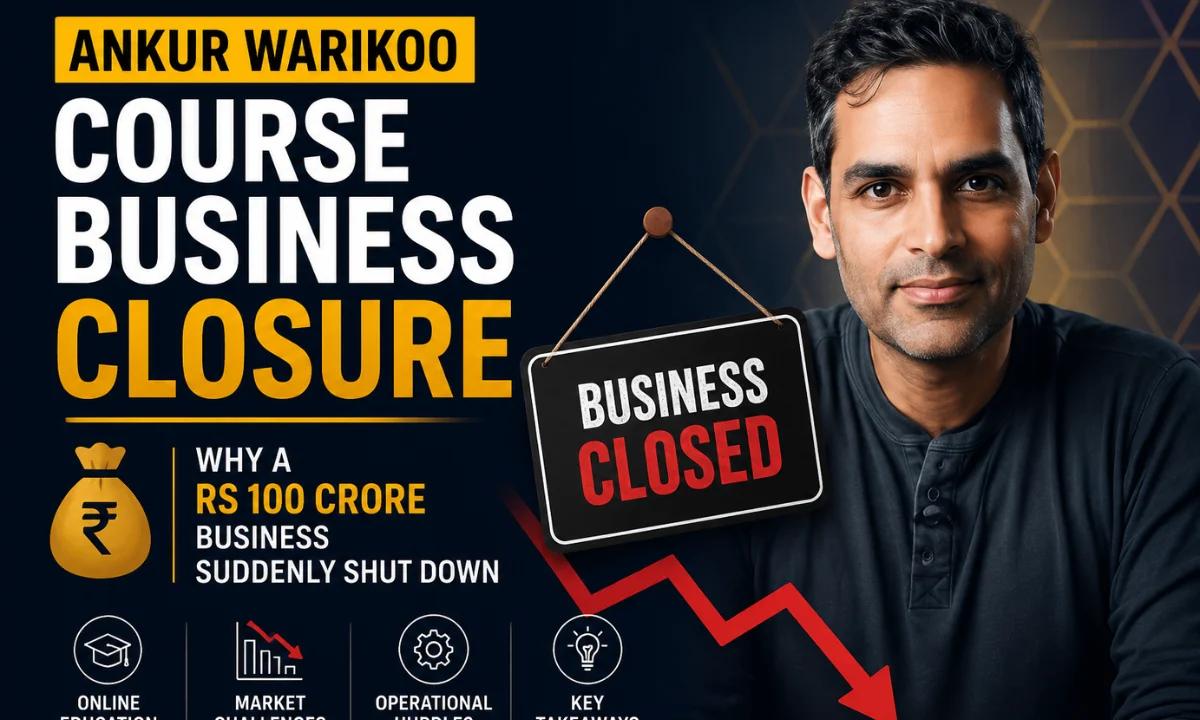
Ankur Warikoo Course Business Closure: Why A Rs 100 Crore Business Suddenly Shut Down
Ankur Warikoo’s latest announcement has created massive buzz across the Indian creator economy. The entrepreneur, author and content creator revealed that he is shutting down his online courses business despite claiming it crossed Rs 100 crore in sales and generated around Rs 25 crore in profits.
Naturally, people on social media were confused. Some called it bold. Others said it looked like a smart marketing play before a new launch.
What made this news even more interesting is the timing. Online learning, personal branding and creator-led education are still growing in India.
So when someone with nearly five lakh students says “it makes no sense to continue”, people start asking questions. Is this about AI changing education? Is the online course industry slowing down? Or is there a bigger strategy behind the move?
Key Takeaways On Ankur Warikoo Course Business Closure
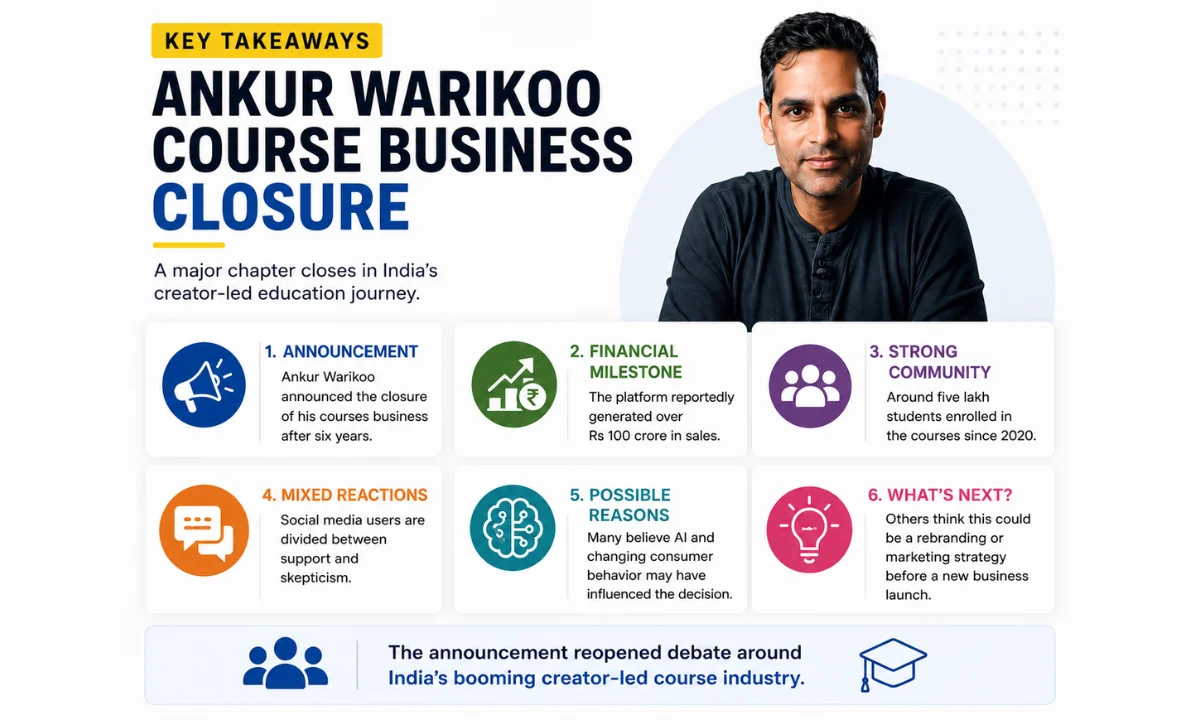
- Ankur Warikoo announced the closure of his courses business after six years.
- The platform reportedly generated over Rs 100 crore in sales.
- Around five lakh students enrolled in the courses since 2020.
- Social media users are divided between support and skepticism.
- Many people believe AI and changing consumer behavior may have influenced the decision.
- Others think this could be a rebranding or marketing strategy before a new business launch.
- The announcement reopened debate around India’s booming creator-led course industry.
The discussion around the shutdown has now become much bigger than just one business. It has turned into a conversation about the future of online education, influencer-led courses and how creators are adapting to changing internet trends.
Why Ankur Warikoo’s Announcement Went Viral
The internet loves unexpected business decisions. Especially when a profitable company gets shut down without warning.
Warikoo shared that his online courses business had achieved numbers far beyond his expectations. According to him, the venture crossed Rs 100 crore in revenue with nearly Rs 25 crore in profits. In normal startup language, that sounds like a success story. That is exactly why people were surprised.
Most founders scale profitable businesses instead of shutting them down. So when Warikoo wrote that continuing the business “makes no sense”, curiosity exploded online. People instantly started creating theories.
Some users believed the business may have slowed down recently despite good lifetime numbers. Others felt the announcement looked like a classic attention-building strategy before launching something new.
That mix of confusion and curiosity is exactly what pushed the topic viral on X and LinkedIn.
The Silent Death of the Passive Income Video Course
One thing many competitor articles missed is the larger shift happening in the online learning industry right now.
Back in 2020 and 2021, online courses were booming. Everyone was learning new skills from home. Creators started selling courses on productivity, freelancing, finance, content creation and startup growth. Indian audiences were buying heavily because digital education felt fresh and valuable.
But in 2026, the market looks different.
People have become more selective. Free content on YouTube has improved massively. AI tools can now summarize books, explain concepts and even create learning plans in seconds. Many users are now questioning whether expensive creator courses still offer enough unique value.
That is probably why Warikoo’s reply about AI caught attention online. When a user asked whether AI influenced the decision, he replied:
“It should. And it has.”
That single line opened another layer of discussion.
The Tech Disruption: How Generative AI Broke the Traditional Creator Playbook
AI is quietly disrupting the entire online education space.
Earlier, creators had an advantage because information was difficult to organize. Now tools like ChatGPT, Gemini and other AI assistants can explain productivity systems, startup basics, personal finance concepts and marketing frameworks instantly.
This creates two major problems for course businesses:
| Old Online Course Model | AI Era Learning Model |
|---|---|
| Recorded video lessons | Instant AI explanations |
| Fixed curriculum | Personalized learning |
| Expensive enrollment | Mostly free tools |
| Passive learning | Interactive learning |
| Generic advice | Customized responses |
People are no longer paying only for information. They now pay for community, accountability, mentorship and execution support.
That shift is massive.
Many creators may now have to redesign their businesses completely instead of relying only on recorded video courses.
Genius Strategy or Overhyped Hype? What the Internet Thinks (Data From X)
Social media reactions around the announcement were honestly quite interesting.
Some users praised Warikoo for walking away from something successful. They felt it showed confidence and long-term thinking. A few people even said most entrepreneurs stay stuck in businesses because of ego, even when they want to move on.
But criticism was equally strong.
A common opinion online was that creator-led courses are becoming overcrowded. People are tired of hearing the same productivity hacks, startup advice and self-improvement frameworks repeated again and again.
One sharp comment compared course selling to insurance sales. The user suggested many influencers earn more money teaching “success” than the students actually applying the lessons.
Harsh? Yes. But that opinion clearly reflects growing skepticism around influencer education businesses.
Beyond Video Tapes: The Next Evolution of the Indian Creator Economy
The creator economy in India is changing very fast now. Earlier, simply having followers was enough to build a profitable business.
Creators launched courses, communities and digital products easily because audiences trusted them. Now audiences are smarter.
People want proof. They want outcomes. They want practical value instead of motivational content. This is why many creators are slowly shifting toward:
- Consulting
- Cohort-based learning
- AI-powered tools
- Private communities
- Subscription businesses
- Live workshops
- SaaS products
The “record videos once and sell forever” model is becoming harder to sustain unless the creator has very strong authority or unique expertise.
That context makes Warikoo’s announcement much more interesting. Because this may not just be about one creator shutting a business. It may actually reflect where the entire industry is heading.
Could This Be A Marketing Move?
Of course, this is the internet. So people immediately started suspecting a rebrand or a new launch. Honestly, that theory is not impossible.
Creators often build suspense before launching a new product, book, app or community. A dramatic announcement naturally increases attention. That attention later converts into traffic and engagement.
Some users online openly called the shutdown a “marketing hook”. But even if that turns out to be true, the discussion it created is still important. Because people are clearly questioning the future of online courses more seriously now. The conversation itself reveals changing audience behavior.
What Young Entrepreneurs Can Learn From This
One underrated part of this story is the mindset behind shutting something down.
In India, many people are taught to hold onto profitable businesses forever. But modern internet entrepreneurs think differently.
Sometimes creators shut businesses because:
- Their interests change
- The market changes
- Consumer behavior shifts
- New technology disrupts old models
- The business no longer feels exciting
- Bigger opportunities appear
That does not automatically mean failure. In fact, many successful founders reinvent themselves multiple times.
Warikoo himself has shifted across startups, investing, writing, public speaking and content creation over the years. So this decision may simply be another transition phase.
Why This Story Matters Beyond Social Media
At first glance, this looked like another viral creator post. But the deeper discussion is actually about digital business sustainability. Questions people are asking now include:
- Are online courses becoming oversaturated?
- Will AI reduce demand for paid learning content?
- Can creator businesses survive without constant reinvention?
- Are audiences losing trust in self-help content?
- What type of education products will work in the future?
These are serious questions for India’s growing creator economy. Especially because thousands of small creators are currently trying to build businesses around courses, mentorships and digital education.
My Final Words On Ankur Warikoo Course Business Closure
The sudden closure of Ankur Warikoo’s ₹100 crore digital course ecosystem is a massive wake-up call for internet entrepreneurs. It proves that what worked during the 2020 digital boom is no longer sustainable in a mature, tech-driven market.
The real story here isn’t just about one creator closing up shop it’s about a massive structural shift in how internet audiences consume information.
The sudden closure of Ankur Warikoo’s ₹100 crore digital course ecosystem is a massive wake-up call for internet entrepreneurs. It proves that what worked during the 2020 digital boom is no longer sustainable in a mature, tech-driven market.
The real story here isn’t just about one creator closing up shop it’s about a massive structural shift in how internet audiences consume information.
Why the “Record-and-Forget” Model is Broken
- The Information Arbitrage Is Gone: Generative AI tools like ChatGPT and Gemini have flattened the information curve. Anyone can access structured knowledge for free, killing the demand for generic video lecture setups.
- The Rise of Skepticism: Indian audiences are experiencing “infopreneur fatigue.” They are moving away from polished, motivational storytelling and demanding verifiable proof of work and direct execution.
- The Shift from Content to Outcome: Monetization in 2026 requires deeper value. High-paying audiences are bypassing pre-recorded packages in favor of community accountability, dynamic mentorship, and hands-on tools.
- The Information Arbitrage Is Gone: Generative AI tools like ChatGPT and Gemini have flattened the information curve. Anyone can access structured knowledge for free, killing the demand for generic video lecture setups.
- The Rise of Skepticism: Indian audiences are experiencing “infopreneur fatigue.” They are moving away from polished, motivational storytelling and demanding verifiable proof of work and direct execution.
- The Shift from Content to Outcome: Monetization in 2026 requires deeper value. High-paying audiences are bypassing pre-recorded packages in favor of community accountability, dynamic mentorship, and hands-on tools.
Related Posts :

Share This Post