Iranian Warship Sinks In Indian Ocean: US Submarine Torpedo Attack Near Sri Lanka Raises Global Tensions
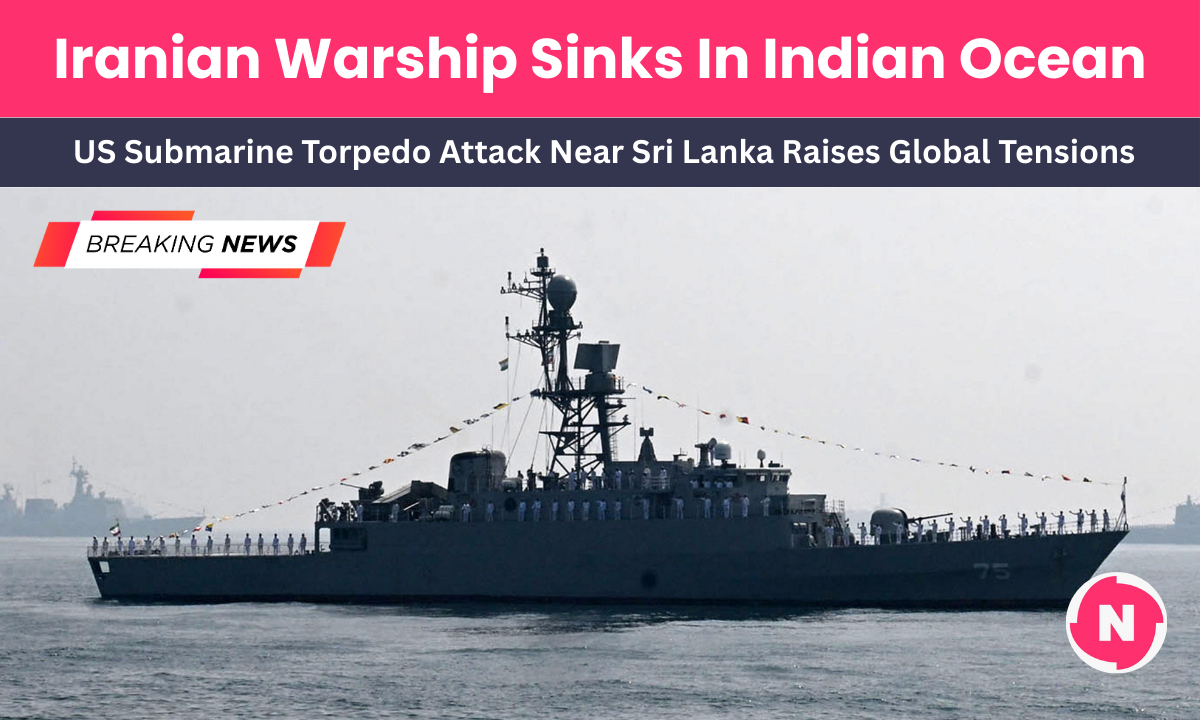
Iranian Warship Sinks In Indian Ocean: US Submarine Torpedo Attack Near Sri Lanka Raises Global Tensions | Image Via © BBC
The news about an Iranian warship sinking in the Indian Ocean has shocked many countries across the world. The Iranian naval frigate IRIS Dena was reportedly hit by a torpedo fired from a United States submarine near the southern coast of Sri Lanka. The incident happened while the warship was returning to Iran after attending international naval exercises hosted by India in Visakhapatnam.
This development has quickly turned into a major geopolitical issue. The strike took place in international waters but very close to India’s strategic maritime region. Because of this location, analysts say the Iran conflict has now reached the Indian Ocean region, which is important for global trade and security.
Key Takeaways
- Iranian warship IRIS Dena sank in the Indian Ocean after a suspected US submarine torpedo strike.
- The incident happened near Sri Lanka in international waters.
- Around 180 sailors were believed to be onboard the warship.
- Sri Lankan navy launched rescue operations and recovered survivors and bodies.
- The ship had recently participated in Exercise Milan hosted by India in Visakhapatnam.
- Experts say the attack shows the Iran conflict is spreading beyond the Middle East.
- The incident has raised questions about security in the Indian Ocean region.
H2 Understanding The Iranian Warship IRIS Dena Incident
The Iranian naval frigate IRIS Dena sank in the Indian Ocean after being struck by a torpedo reportedly fired by a US nuclear powered submarine. The attack happened early in the morning while the ship was sailing south of Sri Lanka.
According to reports, the vessel had around 180 crew members onboard. Sri Lankan authorities recovered dozens of bodies from the water and managed to rescue several sailors who survived the blast. Many crew members were still missing when rescue operations began.
The warship sent a distress call before it completely sank. Sri Lanka quickly launched a search and rescue mission using navy ships and aircraft. Rescuers later reported seeing an oil slick in the sea and debris floating in the water. Survivors were transported to hospitals in the southern city of Galle for treatment.
H2 What Was The IRIS Dena Doing Near India
One reason this incident gained huge global attention is because the warship had recently visited India.
The IRIS Dena participated in the multinational naval exercise called Milan which was organised by the Indian Navy in Visakhapatnam. The event included naval ships from several countries and focused on maritime cooperation and security in the Indo Pacific region.
After the naval exercise ended, the Iranian ship started its journey back to Iran. The planned route reportedly included passing through the Indian Ocean before entering the Persian Gulf.
During this return journey the vessel was targeted and sunk near Sri Lanka. This connection with India is one of the reasons why the event is being discussed widely across South Asia.
H2 Casualties And Rescue Operations
The attack caused heavy casualties among the crew members. Sri Lankan officials said the warship had about 180 sailors onboard when the incident happened.
The situation can be understood better from the following data.
Crew Situation After The Attack
| Category | Details |
|---|---|
| Total Crew Onboard | Around 180 sailors |
| Bodies Recovered | More than 80 reported |
| Rescued Survivors | Around 30 sailors |
| Missing Crew | Dozens still unaccounted |
Sri Lanka responded quickly because the distress signal was received inside its designated search and rescue region in the Indian Ocean.
Naval ships and aircraft were deployed to locate survivors. Many injured sailors were transported to Karapitiya Hospital in Galle for treatment.
Officials said their response followed international maritime rules which require countries to assist ships in distress regardless of nationality.
H2 Why The Location Of The Attack Is Important
The sinking of the Iranian warship is significant mainly because of where it happened. The strike took place in the Indian Ocean close to India and Sri Lanka. This region is considered strategically important for several reasons.
Key reasons the location matters:
- The Indian Ocean handles a large portion of global trade routes.
- Major powers maintain naval presence in this region.
- India considers these waters part of its strategic security environment.
- The attack happened close to South Asian territory even though it was in international waters.
Experts say that even though the strike did not occur inside Indian territorial waters, it still brings global conflict closer to the region. This has raised concerns about maritime security and stability in South Asia.
H2 Rare Case Of A Warship Being Sunk By A Submarine
Another reason why this event is making headlines is because such incidents are extremely rare in modern naval warfare. Submarine torpedo attacks on warships have become uncommon after World War II. Naval experts say only a few warships have been sunk by submarines in the last several decades. Reasons Why Submarine Attacks Are Rare
• Modern ships have advanced detection systems
• Naval forces rely more on missiles and air strikes
• Submarine warfare usually focuses on stealth and intelligence
• Direct torpedo attacks on large vessels are uncommon
Because of this rarity, the sinking of the IRIS Dena is considered a major military development.
H2 Role Of The US Navy In The Indian Ocean
Reports suggest that the strike was carried out by a US attack submarine operating in the Indian Ocean. The United States maintains a strong naval presence in this region through its Fifth Fleet which operates across the Persian Gulf, Arabian Sea and surrounding waters.
The US Navy often deploys several types of vessels in this region such as:
| Type Of Naval Asset | Purpose |
|---|---|
| Aircraft Carriers | Air power projection |
| Destroyers | Missile defence and escort |
| Attack Submarines | Surveillance and strike capability |
| Support Ships | Logistics and supply |
Military analysts believe the presence of American submarines in the Indian Ocean is part of broader strategic operations related to the Iran conflict.
H2 Why This Incident Matters For India
Even though the incident did not happen inside India’s maritime territory, it still has strategic implications. India maintains strong interests in the Indian Ocean because it is a major trade route and a key security region. Several factors connect India to this situation:
• The Iranian ship had recently visited an Indian naval event
• The strike happened close to India’s maritime region
• India maintains relations with both Iran and the United States
• The Indian Ocean is central to India’s maritime security policy
Because of these factors, analysts say India will closely monitor how the situation develops.
H2 Public Opinion And Reactions
Discussions about the Iranian warship sinking quickly spread across social media platforms. Many analysts and commentators shared their views about what the incident means for global security.
Some defence experts said the event shows the Iran conflict is expanding beyond the Middle East. Others pointed out that the strike occurring near South Asia makes the situation more sensitive for regional powers like India.
Several commentators also highlighted that the attack happened in international waters, meaning it did not violate the territorial boundaries of nearby countries. The general public reaction online reflects concern about rising global tensions and the possibility of the conflict spreading to new regions.
H2 What Could Happen Next
The sinking of the IRIS Dena has added another layer to the ongoing Iran related conflict. Possible developments experts are watching include:
• Increased naval presence in the Indian Ocean
• More security cooperation among regional countries
• Diplomatic responses from affected nations
• Continued rescue and investigation efforts
For now, rescue operations and humanitarian support for survivors remain the immediate priority. At the same time, the global community will closely observe how this event affects geopolitical relations and maritime security in the Indian Ocean.
Share This Post